You are here: Home > Doctor Kits > Moral Emblems and Other Poems, by Robert Louis Stevenson Full text
Time: 2026-07-29 23:15:52 Source: Web compilation Editor: Doctor Kits
Transcribed from the 1921 Chatto and Windus edition by DavidPrice, email [email protected] EMBLE best sewing kits for 13 year olds under 100 dollars
Transcribed from the 1921 Chatto and best sewing kits for 13 year olds under 100 dollarsWindus edition by DavidPrice, email [email protected]
& OTHER POEMS WRITTEN AND
ILLUSTRATED WITH WOODCUTS
BY ROBERT LOUIS STEVENSON
FIRST PRINTED AT THE DAVOS
PRESS BY LLOYD OSBOURNE
AND WITH A PREFACE
BY THE SAME
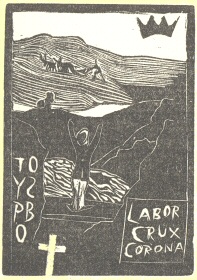
LONDON
CHATTO & WINDUS
1921
All rights reserved
It is with some diffidence that Isit down at an age so mature that I cannot bring myself to nameit, to write a preface to works I printed and published attwelve.
I would have the reader see a little boy living in achâlet on a Swiss mountain-side, overlooking a stragglingvillage named Davos-Platz, where consumptives coming to get wellmore often died. It was winter; the sky-line was broken byfrosty peaks; the hamlet—it was scarcely morethen—lay huddled in the universal snow. Morning camelate, and the sun set early. A still, silent and icy nighthad an undue share of the round of hours, which at least it hadthe grace to mitigate by a myriad of shining stars.
The little boy thought it was a very jolly place. Heloved the tobogganing, the skating, the snow-balling; loved thecrisp, p.vitingling air, and the woods full of Christmas trees,glittering with icicles. Nor with his toy theatre andprinting-press was the indoor confinement ever irksome. Hebut dimly appreciated that his stepfather and mother were lesshappy in so favoured a spot. His mother’s face wasoften anxious; sometimes he would find her crying. Hisstepfather, whom he idolised, was terribly thin, and even tochildish eyes looked frail and spectral. The stepfather wasan unsuccessful author named Robert Louis Stevenson, who wouldnever have got along at all had it not been for his rich parentsin Edinburgh. The little boy at his lessons in the roomwhich they all shared grew used to hearing a sentence that struckat his heart. Perhaps it was the tone it was uttered in;perhaps the looks of discouragement and depression that went withit.
‘Fanny, I shall have to write to my father.’
It served to make the little boy very p. viiprecociousabout money. In a family perennially short of it he learnedits essentialness early. He knew too, that he was adreadfully expensive child. His stepfather paid fortypounds for his winter’s tutoring, not to speak of anadditional outlay on a dying Prussian officer who taught himGerman with the aid of a pocket-knife stuck down his throat togive him the right accent. It was with consternation thathe once heard his stepfather say in a voice of tragedy:‘Good Heavens, Fanny, we are spending ten pounds a week onfood alone!’
The little boy, under the stress of this financial urgency,decided to go into business, finding a capital opening in theHotel Belvidere, where a hundred programmes were required weeklyfor the Saturday night concerts. A gentleman with a blackbeard, who was in charge of these arrangements, willingly offeredto pay two francs fifty centimes for each set ofprogrammes. The little boy was afraid of the gentleman p. viiiwith theblack beard; he was a formidable gentleman, with a formidablemanner, and he was very exacting about spelling. Thegentleman with the black beard attached an inordinate importanceto spelling. The gentleman with the black beard was whollyunable to make allowances for the trifling mistakes that willoccur in even the best-managed of printing-offices. If thelittle boy printed: ‘’Twas in Trofolgar’s Bay .. . sung by Mr. Edwin Smith,’ the black-bearded gentlemanhad no mercy in sending that poor little boy back to do it allover again. But he paid promptly—a severe man, butextremely honourable. There were charity-bazaars too,public invitations, announcements, letter-heads, all bringinggrist to the mill. The ‘Elegy for Some LeadSoldiers’ was brought out, and sold for a penny. Oncethere was a colossal order for a thousand lottery tickets.
The little boy’s ambitions soared. He wrote andprinted a tiny book of eight p. ixpages, entitled ‘Black Canyon,or Life in the Far West,’ in which he used all the‘cuts’ he had somehow accumulated with histype—the story conforming to the illustrations instead ofthe more common-place way of the illustrations conforming to thetext. This work can occasionally be picked up at one ofSotheby’s auctions, and if you can get it for less thantwenty-five pounds you are lucky—that is if you are acollector and prize such things. It has risen to thedignity of ‘Davos Booklets;Stevensoniana; excessively rare.’ But itsoriginal price was sixpence, and its sale was immediate andgratifying. The little boy discovered that there was muchmore money to be made from one book than a dozen sets ofprogrammes, and that without any black-bearded gentleman eitherto tweak his nose when errors crept in.
Louis, as the little boy always called his stepfather, with afamiliarity that was p.xmuch criticised by strangers, followed this publishingventure with absorbing interest. Then his own ambitionsawakened, and one day, with an affected humility that was mostembarrassing, he called at the office, and submitted a manuscriptcalled, ‘Not I, and Other Poems,’ which the firm ofOsbourne and Co. gladly accepted on the spot. It was aninstantaneous hit, selling out an entire edition of fiftycopies.
The publisher was thrilled, and the author was equallyjubilant, saying it was the only successful book he had everwritten, and jingling his three francs of royalties with an airthat made the little boy burst out laughing with delightedpride. In the ensuing enthusiasm another book was planned,and the first poem for it written.
‘If only we could have illustrations,’ said thepublisher longingly. But his ‘cuts’ had allbeen used in ‘Black Canyon, or Life in the FarWest.’ Illustrations had to be p. xiput by as adream impossible of fulfilment. No, not impossible! Louis, who was a man of infinite resourcefulness (he could paintbetter theatre-scenes than any one could buy), said that he wouldtry to carve some pictures on squares of fretwood. The wordfretwood seems as unknown nowadays as the thing itself; it was anextremely thin piece of board with which one was supposed to makeworks of art with the help of pasted-on patterns, an aggravatinglittle saw, and the patience of Job. . . . Well, Louis cutout a small square of fretwood, and in a deeply-thoughtful mannerapplied himself to the task. He had only a pocket-knife;real tools came later; but he was impelled by a will to win thatcarried all before it. After an afternoon of almostsuffocating excitement—for the publisher—he completedthe engraving that accompanies the poem: ‘Reader, your soulupraise to see.’ But it had yet to be mounted on awooden block in order to p. xiiraise it to the exact level of thetype. At last this was done. A proof was runoff. But the impression was unequal. Oh, thedisappointment! Author and publisher gazed at each other inmisery. But woman’s wit came to the rescue. Whynot build it up with cigarette papers? ‘Bravo,Fanny!’ The author set to work, deftly andskilfully. Then more proofs, more cigarette-papers, morerunning up and down stairs to the little boy’s room, whichin temperature hovered about zero. But what wastemperature? The thing was a success. The little boy,entranced beyond measure, printed copy after copy from the sheerpleasure of seeing the wet ink magically reproducing theblock.
The next day the little boy was sent to a dyingSwiss—half the population of Davos were coughing away theremnants of life—who lived with his poverty-stricken familyin one room, earning their bread by carving bears. A modelblock was shown him. p. xiiiCould he reproduce a dozen exactlylike it, but in a wood without any grain? The dying Swisssaid he could, leaving his bear forthwith, and applying himselfto the task. The pinched-face children looked on amazed;the little print of ‘Reader, your soul upraise tosee’ was passed from hand to hand with exclamations ofastonishment. The dying Swiss gave the little boy theblocks, beautifully and faultlessly finished. Would thelittle boy care to buy a bear? No, the little boydidn’t. He scurried home through the snow with theprecious blocks.
Thus ‘Moral Emblems’ came out; ninety copies,price sixpence. Its reception might almost be calledsensational. Wealthy people in the Hotel Belvidere boughtas many as three copies apiece. Friends in England wroteback for more. Meanwhile the splendid artist wasassiduously busy. He worked like a beaver, saying that itwas the best relaxation he had ever found. The little boyonce overheard him confiding p. xivto a visitor: ‘I cannot tellyou what a Godsend these silly blocks have been to me. WhenI can write no more, and read no more, and think no more, I canpass whole hours engraving these blocks in blissfulcontentment.’ These may not have been the actualwords, but such at least was their sense.
Thus the second ‘Moral Emblems’ came out; ninetycopies, price ninepence. The public welcomed it as heartilyas the first, the little boy becoming so prosperous that heaccumulated upwards of five pounds. But let it never besaid that he spurned the humble mainstay of his beginnings. He printed the weekly programmes as usual, and bore the exactionsof the black-bearded gentleman with fortitude. When he madesuch a trifling mistake, for instance, as ‘The Harp thatOnce Through Tara’s Hells,’ he dutifully climbed thehill to his freezing room, and ran off a whole fresh set. Two francs fifty was two francs fifty. p. xvEvery business man appreciates thecomfort of a small regular order which can be counted on like theclock.
But one day there was no black-bearded gentleman. ‘Oh, he was dead. Had had a hemorrhage three daysbefore and had died.’ I don’t know whether thelittle boy mourned for him particularly, but it was a shock tolose that two francs fifty centimes. The little boy wasworried until he found a lady who had substituted herself for thegentleman with the black beard. She was a very kind lady;you could print anything for that lady, and ‘get away withit’ as Americans say. But she was frolicsome andlacked poise; she was vague about appointments, and had adisheartening way of saying: ‘Oh, bother,’ when thelittle boy appeared; she would insist on kissing him amidcircumstances of the most odious publicity; was so abased acreature besides, that she often marred the programmes by makingpen-and-ink corrections. In p. xvicontrast, the little boy looked backon the black-bearded gentleman almost with regret.
Two winters were thus occupied, with incidental education thatseemed far less important. The Prussian officer hadfortunately died, releasing the little boy from any further studyof German. All that he retains of it to-day is the taste ofthat pocket-knife, and of the Prussian officer’sthumb. Then he was sent to boarding-school in England, orto be precise to a tutor who had half a dozen residentpupils. Time passed; publishing became a memory. Thena long summer holiday found the little boy, now much grown andmatured, reunited with his family in Kingussie. Theprinting-press was there, and business was resumed withenthusiasm. The stepfather, who had made much more progresswith engraving than the boy had with Latin, had the blocks andpoems all ready for ‘The Graver and the Pen.’
But the printing-press broke down; and p. xviiafter aninterval of despair and unavailing attempts to repair it, anamiable old man was found who had a press of his own behind amicroscopic general shop. Here ‘The Graver and thePen’ was printed with what now seems an almost regrettableperfection. The amiable old man was altogether tooamiable. He would insist on doing far too much himself,though he had been merely paid a trifling rent for the use of thepress. An edition of a hundred copies was printed, of whichalmost none were sold. The little boy had grown such a bigboy that he was ashamed of tradesmanship. He had passed theage when he could take sixpences and ninepences with ease fromstrangers. New standards were imperceptibly forming, and itpleased him better to see his stepfather give away ‘TheGraver and the Pen’ to those worthy of so signal anhonour.
In fact ‘The Graver and the Pen’ was the lastenterprise of Osbourne and Co. ‘The p. xviiiPirateand the Apothecary’ was projected; three superbillustrations were engraved for it; yet it never saw more lightthan the typewriter afforded. ‘The Builder’sDoom’ has remained in manuscript until the presenttime. No illustrations were either drawn or engraved forit. It marked the final decline of a once flourishingbusiness, which in its day had given so much laughter to manypeople sadly in need of it.
LLOYD OSBOURNE.
| PAGE | |
PREFACE | v | |
NOT I, AND OTHER POEMS— | ||
I. | Some like drink | 3 |
II. | Here, perfect to a wish | 4 |
III. | As seamen on the seas | 5 |
IV. | The pamphlet here presented | 6 |
MORAL EMBLEMS: A COLLECTION OF CUTS ANDVERSES— | ||
I. | See how the children in the print | 9 |
II. | Reader, your soul upraise to see | 11 |
III. | A PEAK IN DARIEN—Broad-gazing on untrodden lands | 13 |
IV. | See in the print how, moved by whim | 15 |
V. | Mark, printed on the opposing page | 17 |
p.xxMORAL EMBLEMS: A SECOND COLLECTION OF CUTS ANDVERSES— | ||
I. | With storms a-weather, rocks-a-lee | 21 |
II. | The careful angler chose his nook | 23 |
III. | The Abbot for a walk went out | 25 |
IV. | The frozen peaks he once explored | 27 |
V. | Industrious pirate! see him sweep | 29 |
A MARTIAL ELEGY FOR SOME LEADSOLDIERS— | ||
| For certain soldiers lately dead | 33 |
THE GRAVER AND THE PEN: OR, SCENES FROMNATURE, WITH APPROPRIATE VERSES | ||
I. | PROEM—Unlike the common run of men | 37 |
II. | THE PRECARIOUS MILL—Alone above the stream itstands | 41 |
III. | THE DISPUTATIOUS PINES—The first pine to the secondsaid | 45 |
p. xxiIV. | THE TRAMPS—Now long enough had day endured | 49 |
V. | THE FOOLHARDY GEOGRAPHER—The howling desert milesaround | 51 |
VI. | THE ANGLER AND THE CLOWN—The echoing bridge you heremay see | 55 |
MORAL TALES— | ||
I. | ROBIN AND BEN: OR, THE PIRATE AND THEAPOTHECARY—Come, lend me an attentive ear | 59 |
II. | THE BUILDER’S DOOM—In eighteen-twenty DeaconThin | 73 |
Some like drink
In a pint pot,
Some like to think;
Some not.
Strong Dutch cheese,
Old Kentucky rye,
Some like these;
Not I.
Some like Poe,
And others like Scott,
Some like Mrs. Stowe;
Some not.
Some like to laugh,
Some like to cry,
Some like chaff;
Not I.
Here, perfect to a wish,
We offer, not a dish,
But just the platter:
A book that’s not a book,
A pamphlet in the look
But not the matter.
I own in disarray:
As to the flowers of May
The frosts of Winter;
To my poetic rage,
The smallness of the page
And of the printer.
As seamen on the seas
With song and dance descry
Adown the morning breeze
An islet in the sky:
In Araby the dry,
As o’er the sandy plain
The panting camels cry
To smell the coming rain:
So all things over earth
A common law obey,
And rarity and worth
Pass, arm in arm, away;
And even so, to-day,
The printer and the bard,
In pressless Davos, pray
Their sixpenny reward.
The pamphlet here presented
Was planned and printed by
A printer unindented,
A bard whom all decry.
The author and the printer,
With various kinds of skill,
Concocted it in Winter
At Davos on the Hill.
They burned the nightly taper;
But now the work is ripe—
Observe the costly paper,
Remark the perfect type!
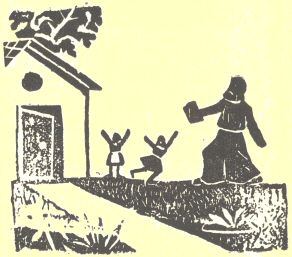
See how the children in the print
Bound on the book to see what’s in ’t!
O, like these pretty babes, may you
Seize and applythis volume too!
And while your eye upon the cuts
With harmless ardour opes and shuts,
Reader, may your immortal mind
To their sage lessons not be blind.
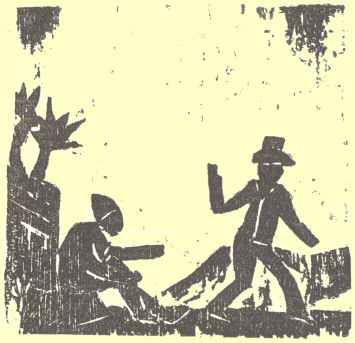
Reader, your soul upraise to see,
In yon fair cut designed by me,
The pauper by the highwayside
Vainly soliciting from pride.
Mark how the Beau with easy air
Contemns the anxious rustic’s prayer,
And, casting a disdainful eye,
Goes gaily gallivanting by.
He from the poor averts his head . . .
He will regret it when he’s dead.
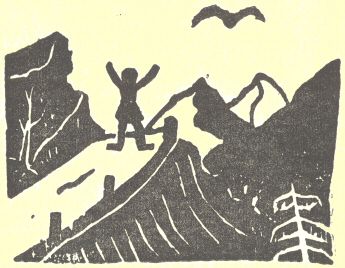
Broad-gazing on untrodden lands,
See where adventurous Cortez stands;
While in the heavens above his head
The Eagle seeks its daily bread.
How aptly fact to fact replies:
Heroes and eagles, hills and skies.
Ye who contemn the fatted slave
Look on this emblem, and be brave.
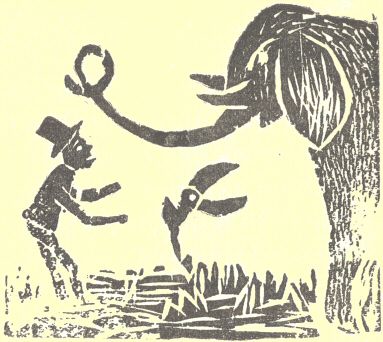
See in the print how, moved by whim,
Trumpeting Jumbo, great and grim,
Adjusts his trunk, like a cravat,
To noose that individual’s hat.
The sacred Ibis in the distance
Joys to observe his bold resistance.
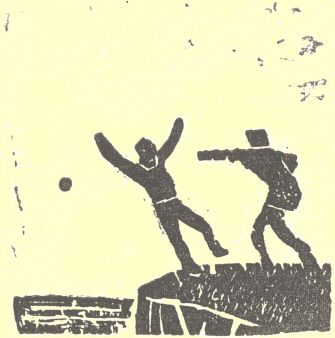
Mark, printed on the opposing page,
The unfortunate effects of rage.
A man (who might be you or me)
Hurls another into the sea.
Poor soul, his unreflecting act
His future joys will much contract,
And he will spoil his evening toddy
By dwelling on that mangled body.
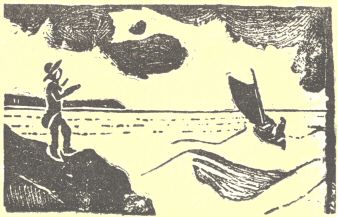
With storms a-weather, rocks a-lee,
The dancing skiff puts forth to sea.
The lone dissenter in the blast
Recoils before the sight aghast.
But she, although the heavens be black,
Holds on upon the starboard tack,
For why? although to-day she sink,
Still safe she sails in printer’s ink,
And though to-day the seamen drown,
My cut shall hand their memory down.
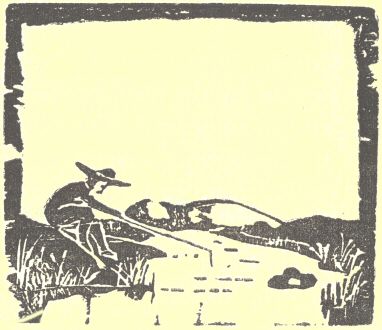
The careful angler chose his nook
At morning by the lilied brook,
And all the noon his rod he plied
By that romantic riverside.
Soon as the evening hours decline
Tranquilly he’ll return to dine,
And, breathing forth a pious wish,
Will cram his belly full of fish.
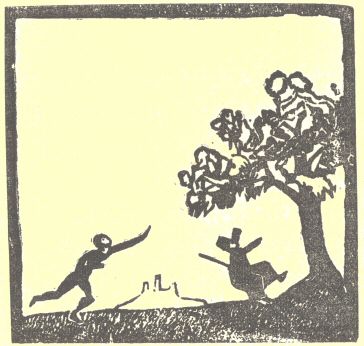
The Abbot for a walk went out,
A wealthy cleric, very stout,
And Robin has that Abbot stuck
As the red hunter spears the buck.
The djavel or the javelin
Has, you observe, gone bravely in,
And you may hear that weapon whack
Bang through the middle of his back.
Hence we may learn that Abbots should
Never go walking in a wood.
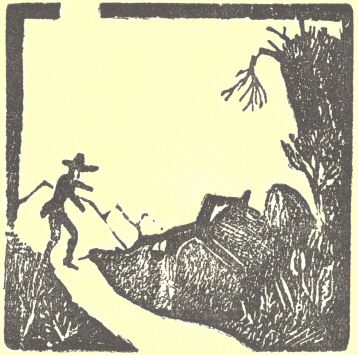
The frozen peaks he once explored,
But now he’s dead and by the board.
How better far at home to have stayed
Attended by the parlour maid,
And warmed his knees before the fire
Until the hour when folks retire!
So, if you would be spared to friends,
Do nothing but for business ends.
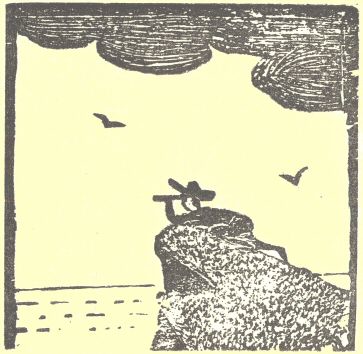
Industrious pirate! see him sweep
The lonely bosom of the deep,
And daily the horizon scan
From Hatteras or Matapan.
Be sure, before that pirate’s old,
He will have made a pot of gold,
And will retire from all his labours
And be respected by his neighbours.
You also scan your life’s horizon
For all that you can clap your eyes on.
For certain soldiers lately dead
Our reverent dirge shall here be said.
Them, when their martial leader called,
No dread preparative appalled;
But leaden-hearted, leaden-heeled,
I marked them steadfast in the field.
Death grimly sided with the foe,
And smote each leaden hero low.
Proudly they perished one by one:
The dread Pea-cannon’s work was done!
O not for them the tears we shed,
Consigned to their congenial lead;
But while unmoved their sleep they take,
We mourn for their dear Captain’s sake,
For their dear Captain, who shall smart
Both in his pocket and his heart,
Who saw his heroes shed their gore,
And lacked a shilling to buy more!
Unlike the common run of men,
I wield a double power to please,
And use the GRAVER and the PEN
With equal aptitude and ease.
I move with that illustrious crew,
The ambidextrous Kings of Art;
And every mortal thing I do
Brings ringing money in the mart.
Hence, in the morning hour, the mead,
The forest and the stream perceive
Me wandering as the muses lead—
Or back returning in the eve.
Two muses like two maiden aunts,
The engraving and the singing muse,
Follow, through all my favourite haunts,
My devious traces in the dews.
p.38To guide and cheer me, each attends;
Each speeds my rapid task along;
One to my cuts her ardour lends,
One breathes her magic in my song.
p. 40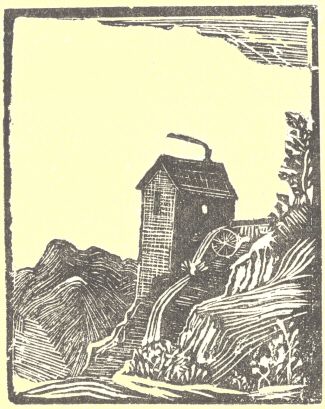
Alone above the stream it stands,
Above the iron hill,
The topsy-turvy, tumble-down,
Yet habitable mill.
Still as the ringing saws advance
To slice the humming deal,
All day the pallid miller hears
The thunder of the wheel.
He hears the river plunge and roar
As roars the angry mob;
He feels the solid building quake,
The trusty timbers throb.
All night beside the fire he cowers:
He hears the rafters jar:
O why is he not in a proper house
As decent people are!
p.42The floors are all aslant, he sees,
The doors are all a-jam;
And from the hook above his head
All crooked swings the ham.
‘Alas,’ he cries and shakes hishead,
‘I see by every sign,
There soon all be the deuce to pay,
With this estate of mine.’
p. 44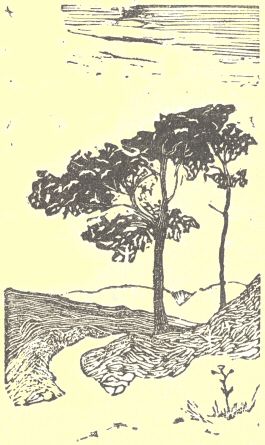
The first pine to the second said:
‘My leaves are black, my branches red;
I stand upon this moor of mine,
A hoar, unconquerable pine.’
The second sniffed and answered:‘Pooh!
I am as good a pine as you.’
‘Discourteous tree,’ the firstreplied,
‘The tempest in my boughs had cried,
The hunter slumbered in my shade,
A hundred years ere you were made.’
The second smiled as he returned:
‘I shall be here when you are burned.’
So far dissension ruled the pair,
Each turned on each a frowning air,
p. 46Whenflickering from the bank anigh,
A flight of martens met their eye.
Sometime their course they watched; and then—
They nodded off to sleep again.
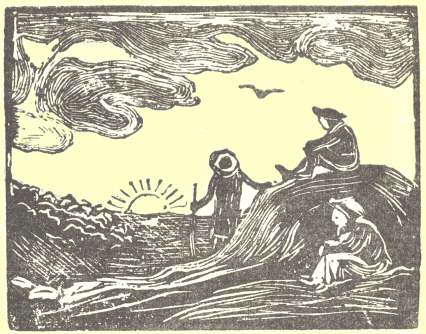
Now long enough had day endured,
Or King Apollo Palinured,
Seaward he steers his panting team,
And casts on earth his latest gleam.
But see! the Tramps with jaded eye
Their destined provinces espy.
Long through the hills their way they took,
Long camped beside the mountain brook;
’Tis over; now with rising hope
They pause upon the downward slope,
And as their aching bones they rest,
Their anxious captain scans the west.
So paused Alaric on the Alps
And ciphered up the Roman scalps.
p. 50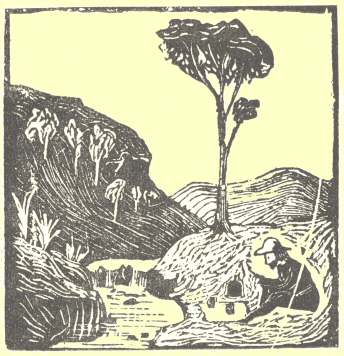
The howling desert miles around,
The tinkling brook the only sound—
Wearied with all his toils and feats,
The traveller dines on potted meats;
On potted meats and princely wines,
Not wisely but too well he dines.
The brindled Tiger loud may roar,
High may the hovering Vulture soar;
Alas! regardless of them all,
Soon shall the empurpled glutton sprawl—
Soon, in the desert’s hushed repose,
Shall trumpet tidings through his nose!
Alack, unwise! that nasal song
Shall be the Ounce’s dinner-gong!
p.52A blemish in the cut appears;
Alas! it cost both blood and tears.
The glancing graver swerved aside,
Fast flowed the artist’s vital tide!
And now the apologetic bard
Demands indulgence for his pard!
p. 54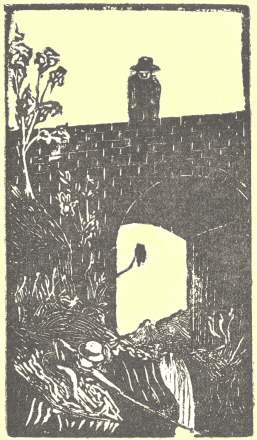
The echoing bridge you here may see,
The pouring lynn, the waving tree,
The eager angler fresh from town—
Above, the contumelious clown.
The angler plies his line and rod,
The clodpole stands with many a nod,—
With many a nod and many a grin,
He sees him cast his engine in.
‘What have you caught?’ the peasantcries.
‘Nothing as yet,’ the Foolreplies.
p. 58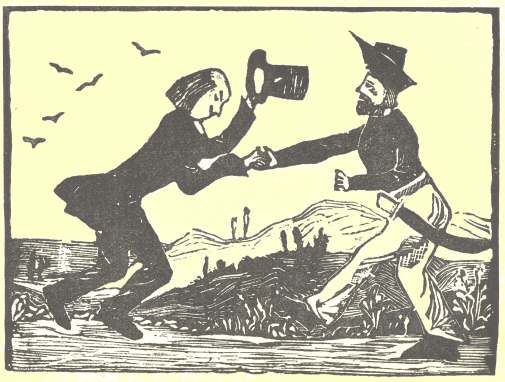
Come, lend me an attentive ear
A startling moral tale to hear,
Of Pirate Rob and Chemist Ben,
And different destinies of men.
Deep in the greenest of the vales
That nestle near the coast of Wales,
The heaving main but just in view,
Robin and Ben together grew,
Together worked and played the fool,
Together shunned the Sunday school,
And pulled each other’s youthful noses
Around the cots, among the roses.
Together but unlike they grew;
Robin was rough, and through and through
Bold, inconsiderate, and manly,
Like some historic Bruce or Stanley.
p. 60Ben had amean and servile soul,
He robbed not, though he often stole.
He sang on Sunday in the choir,
And tamely capped the passing Squire.
At length, intolerant of trammels—
Wild as the wild Bithynian camels,
Wild as the wild sea-eagles—Bob
His widowed dam contrives to rob,
And thus with great originality
Effectuates his personality.
Thenceforth his terror-haunted flight
He follows through the starry night;
And with the early morning breeze,
Behold him on the azure seas.
The master of a trading dandy
Hires Robin for a go of brandy;
And all the happy hills of home
Vanish beyond the fields of foam.
Ben, meanwhile, like a tin reflector,
Attended on the worthy rector;
p. 61Opened hiseyes and held his breath,
And flattered to the point of death;
And was at last, by that good fairy,
Apprenticed to the Apothecary.
So Ben, while Robin chose to roam,
A rising chemist was at home,
Tended his shop with learnèd air,
Watered his drugs and oiled his hair,
And gave advice to the unwary,
Like any sleek apothecary.
Meanwhile upon the deep afar
Robin the brave was waging war,
With other tarry desperadoes
About the latitude of Barbadoes.
He knew no touch of craven fear;
His voice was thunder in the cheer;
First, from the main-to’-gallan’ high,
The skulking merchantmen to spy—
p. 62The firstto bound upon the deck,
The last to leave the sinking wreck.
His hand was steel, his word was law,
His mates regarded him with awe.
No pirate in the whole profession
Held a more honourable position.
At length, from years of anxious toil,
Bold Robin seeks his native soil;
Wisely arranges his affairs,
And to his native dale repairs.
The Bristol Swallowsets him down
Beside the well-remembered town.
He sighs, he spits, he marks the scene,
Proudly he treads the village green;
And, free from pettiness and rancour,
Takes lodgings at the ‘Crown and Anchor.’
Strange, when a man so great and good
Once more in his home-country stood,
Strange that the sordid clowns should show
A dull desire to have him go.
p. 63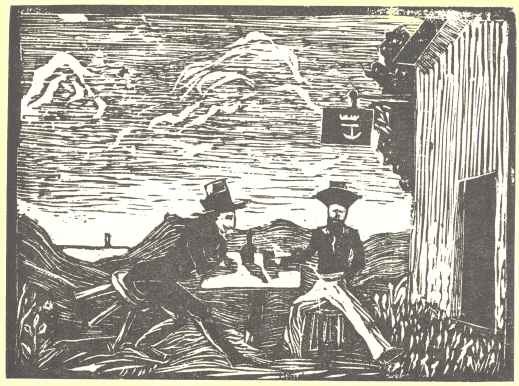
His clinging breeks, his tarry hat,
p. 65The way heswore, the way he spat,
A certain quality of manner,
Alarming like the pirate’s banner—
Something that did not seem to suit all—
Something, O call it bluff, not brutal—
Something at least, howe’er it’s called,
Made Robin generally black-balled.
His soul was wounded; proud and glum,
Alone he sat and swigged his rum,
And took a great distaste to men
Till he encountered Chemist Ben.
Bright was the hour and bright the day
That threw them in each other’s way;
Glad were their mutual salutations,
Long their respective revelations.
Before the inn in sultry weather
They talked of this and that together;
Ben told the tale of his indentures,
And Rob narrated his adventures.
p.66Last, as the point of greatest weight,
The pair contrasted their estate,
And Robin, like a boastful sailor,
Despised the other for a tailor.
‘See,’ he remarked, ‘withenvy, see
A man with such a fist as me!
Bearded and ringed, and big, and brown,
I sit and toss the stingo down.
Hear the gold jingle in my bag—
All won beneath the Jolly Flag!’
Ben moralised and shook his head:
‘You wanderers earn and eat your bread.
The foe is found, beats or is beaten,
And, either how, the wage is eaten.
And after all your pully-hauly
Your proceeds look uncommon small-ly.
You had done better here to tarry
Apprentice to the Apothecary.
The silent pirates of the shore
Eat and sleep soft, and pocket more
p.67Than any red, robustious ranger
Who picks his farthings hot from danger.
You clank your guineas on the board;
Mine are with several bankers stored.
You reckon riches on your digits,
You dash in chase of Sals and Bridgets,
You drink and risk delirium tremens,
Your whole estate a common seaman’s!
Regard your friend and school companion,
Soon to be wed to Miss Trevanion
(Smooth, honourable, fat and flowery,
With Heaven knows how much land in dowry),
Look at me—Am I in good case?
Look at my hands, look at my face;
Look at the cloth of my apparel;
Try me and test me, lock and barrel;
And own, to give the devil his due,
I have made more of life than you.
Yet I nor sought nor risked a life;
I shudder at an open knife;
p. 68Theperilous seas I still avoided
And stuck to land whate’er betided.
I had no gold, no marble quarry,
I was a poor apothecary,
Yet here I stand, at thirty-eight,
A man of an assured estate.’
‘Well,’ answeredRobin—‘well, and how?’
The smiling chemist tapped his brow.
‘Rob,’ he replied, ‘this throbbing brain
Still worked and hankered after gain.
By day and night, to work my will,
It pounded like a powder mill;
And marking how the world went round
A theory of theft it found.
Here is the key to right and wrong:
Steal little, but steal all day long;
And this invaluable plan
Marks what is called the Honest Man.
When first I served with Doctor Pill,
My hand was ever in the till.
p. 69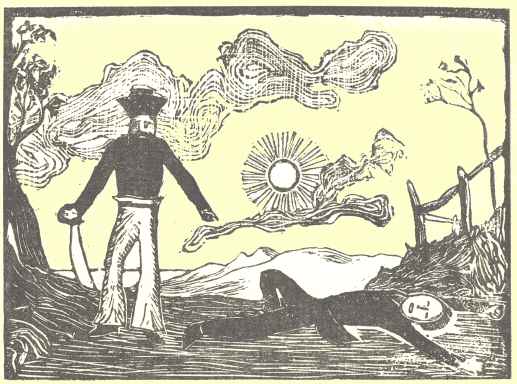
p.71Now that I am myself a master,
My gains come softer still and faster.
As thus: on Wednesday, a maid
Came to me in the way of trade.
Her mother, an old farmer’s wife,
Required a drug to save her life.
‘At once, my dear, at once,’ I said,
Patted the child upon the head,
Bade her be still a loving daughter,
And filled the bottle up with water.’
‘Well, and the mother?’ Robincried.
‘O she!’ said Ben—‘Ithink she died.’
‘Battle and blood, death and disease,
Upon the tainted Tropic seas—
The attendant sharks that chew the cud—
The abhorred scuppers spouting blood—
The untended dead, the Tropic sun—
The thunder of the murderous gun—
p. 72Thecut-throat crew—the Captain’s curse—
The tempest blustering worse and worse—
These have I known and these can stand,
But you—I settle out of hand!’
Out flashed the cutlass, down went Ben
Dead and rotten, there and then.
In eighteen-twenty Deacon Thin
Feu’d the land and fenced it in,
And laid his broad foundations down
About a furlong out of town.
Early and late the work went on.
The carts were toiling ere the dawn;
The mason whistled, the hodman sang;
Early and late the trowels rang;
And Thin himself came day by day
To push the work in every way.
An artful builder, patent king
Of all the local building ring,
Who was there like him in the quarter
For mortifying brick and mortar,
Or pocketing the odd piastre
By substituting lath and plaster?
With plan and two-foot rule in hand,
He by the foreman took his stand,
p. 74Withboisterous voice, with eagle glance
To stamp upon extravagance.
For thrift of bricks and greed of guilders,
He was the Buonaparte of Builders.
The foreman, a desponding creature,
Demurred to here and there a feature:
‘For surely, sir—with your permeession—
Bricks here, sir, in the main parteetion. . . . ’
The builder goggled, gulped, and stared,
The foreman’s services were spared.
Thin would not count among his minions
A man of Wesleyan opinions.
‘Money is money,’ so he said.
‘Crescents are crescents, trade is trade.
Pharaohs and emperors in their seasons
Built, I believe, for different reasons—
Charity, glory, piety, pride—
To pay the men, to please a bride,
To use their stone, to spite their neighbours,
Not for a profit on their labours.
p.75They built to edify or bewilder;
I build because I am a builder.
Crescent and street and square I build,
Plaster and paint and carve and gild.
Around the city see them stand,
These triumphs of my shaping hand,
With bulging walls, with sinking floors,
With shut, impracticable doors,
Fickle and frail in every part,
And rotten to their inmost heart.
There shall the simple tenant find
Death in the falling window-blind,
Death in the pipe, death in the faucet,
Death in the deadly water-closet!
A day is set for all to die:
Caveat emptor! what care I?’
As to Amphion’s tuneful kit
Thebes rose, with towers encircling it;
As to the Mage’s brandished wand
A spiry palace clove the sand;
p. 76ToThin’s indomitable financing,
That phantom crescent kept advancing.
When first the brazen bells of churches
Called clerk and parson to their perches,
The worshippers of every sect
Already viewed it with respect;
A second Sunday had not gone
Before the roof was rattled on:
And when the fourth was there, behold
The crescent finished, painted, sold!
The stars proceeded in their courses,
Nature with her subversive forces,
Time, too, the iron-toothed and sinewed,
And the edacious years continued.
Thrones rose and fell; and still the crescent,
Unsanative and now senescent,
A plastered skeleton of lath,
Looked forward to a day of wrath.
In the dead night, the groaning timber
Would jar upon the ear of slumber,
p. 77And, likeDodona’s talking oak,
Of oracles and judgments spoke.
When to the music fingered well
The feet of children lightly fell,
The sire, who dozed by the decanters,
Started, and dreamed of misadventures.
The rotten brick decayed to dust;
The iron was consumed by rust;
Each tabid and perverted mansion
Hung in the article of declension.
So forty, fifty, sixty passed;
Until, when seventy came at last,
The occupant of number three
Called friends to hold a jubilee.
Wild was the night; the charging rack
Had forced the moon upon her back;
The wind piped up a naval ditty;
And the lamps winked through all the city.
Before that house, where lights were shining,
Corpulent feeders, grossly dining,
p. 78And jollyclamour, hum and rattle,
Fairly outvoiced the tempest’s battle.
As still his moistened lip he fingered,
The envious policeman lingered;
While far the infernal tempest sped,
And shook the country folks in bed,
And tore the trees and tossed the ships,
He lingered and he licked his lips.
Lo, from within, a hush! the host
Briefly expressed the evening’s toast;
And lo, before the lips were dry,
The Deacon rising to reply!
‘Here in this house which once I built,
Papered and painted, carved and gilt,
And out of which, to my content,
I netted seventy-five per cent.;
Here at this board of jolly neighbours,
I reap the credit of my labours.
These were the days—I will say more—
These were the grand old days of yore!
The builder laboured day and night;
He watched that every brick was right:
p.79The decent men their utmost did;
And the house rose—a pyramid!
These were the days, our provost knows,
When forty streets and crescents rose,
The fruits of my creative noddle,
All more or less upon a model,
Neat and commodious, cheap and dry,
A perfect pleasure to the eye!
I found this quite a country quarter;
I leave it solid lath and mortar.
In all, I was the single actor—
And am this city’s benefactor!
Since then, alas! both thing and name,
Shoddy across the ocean came—
Shoddy that can the eye bewilder
And makes me blush to meet a builder!
Had this good house, in frame or fixture,
Been tempered by the least admixture
Of that discreditable shoddy,
Should we to-day compound our toddy,
p. 80Or gailymarry song and laughter
Below its sempiternal rafter?
Not so!’ the Deacon cried.
The mansion
Had marked his fatuous expansion.
The years were full, the house was fated,
The rotten structure crepitated!
A moment, and the silent guests
Sat pallid as their dinner vests.
A moment more and, root and branch,
That mansion fell in avalanche,
Story on story, floor on floor,
Roof, wall and window, joist and door,
Dead weight of damnable disaster,
A cataclysm of lath and plaster.
Siloam did not choose a sinner—
All were not builders at the dinner.
Edinburgh: Printed by T. and A.Constable Ltd.
The Apology, by Xenophon2026-07-29 23:07
Lincoln’s First Inaugural Address2026-07-29 22:51
Lincoln's Gettysburg Address2026-07-29 22:34
The United States' Constitution2026-07-29 22:33
Much Ado about Nothing2026-07-29 22:06
The United States Bill of Rights2026-07-29 22:00
The United States Bill of Rights2026-07-29 21:59
Lincoln’s First Inaugural Address2026-07-29 21:58
The Poetical Works of John Milton, by John Milton2026-07-29 21:44
Through the Looking2026-07-29 21:28
Annals of the Parish, by John Galt2026-07-29 23:06
Alice’s Adventures in Wonderland2026-07-29 22:56
Give Me Liberty Or Give Me Death2026-07-29 22:30
Give Me Liberty Or Give Me Death2026-07-29 22:05
A History of Science, Vol. II by Henry Smith Williams2026-07-29 21:47
Through the Looking2026-07-29 21:38
Give Me Liberty Or Give Me Death2026-07-29 21:32
Alice’s Adventures in Wonderland2026-07-29 21:00
The Natural History of Selborne2026-07-29 20:59
John F. Kennedy's Inaugural Address2026-07-29 20:33
